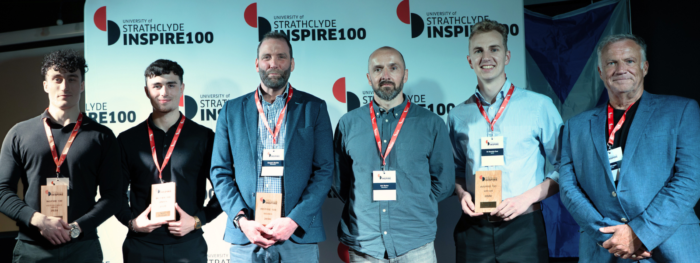
Scensai, Catalyst Neuromorphic, and The Belonging Quotient secure prizes across flagship, net zero and health categories.
Aberdeen innovators have won three national prizes at Scotland’s university innovation awards, spanning the flagship challenge, net zero and health and wellbeing categories. Scensai, led by founder Marcus Campbell Bannerman and Ammar Elhoweris from the University of Aberdeen, was named winner of the flagship Converge Challenge.
Fellow university venture Catalyst Neuromorphic, developed by Henry Shulayev Barnes, secured the Net Zero Challenge, while Shannon Babbie won the Health & Wellbeing prize in the early-stage KickStart Challenge for The Belonging Quotient.
Scensai’s Converge Challenge win marks the first for Aberdeen in over a decade, with the Net Zero and KickStart prizes adding to the university’s performance at this year’s national awards. Scensai’s handheld “electronic nose” is designed to address quality-control issues for the food and beverage industry, initially focusing on whisky production.
The device aims to provide an objective chemical reading on the production floor, helping producers verify cask safety and prevent losses.
Marcus Campbell Bannerman, founder of Scensai, said: “We’re trying to solve quality-control issues for the food and beverage industry and, at the moment, we’re focusing on whisky.
“We’re giving producers something objective they can use to measure a cask and know if it is safe to fill, so they don’t lose money further down the line when the whisky matures. We’re overjoyed. It’s super exciting and such a big privilege. We felt like we’d made it just getting here.”
Producers currently rely on human taste and smell for routine quality checks, with more detailed analysis often requiring samples to be sent to external laboratories. Scensai aims to close this gap by enabling non-specialist staff to detect off-flavours, check batch consistency, and monitor fermentation directly on-site.
The venture’s software also builds a library of chemical signatures, with potential applications in food fraud detection, customs screening, and breath diagnostics.
Aberdeen’s second success, Catalyst Neuromorphic from 18-year-old founder Henry Shulayev Barnes, is developing brain-inspired processors for artificial intelligence tasks.
These processors are designed to use significantly less power than conventional computing, with potential applications in drones, remote field stations, and sensors where battery life is critical. Shulayev Barnes has already built and tested the first version of the Catalyst processor, which features 128 cores and over 32,000 spiking neurons, and a UK patent application has been filed.
Henry Shulayev Barnes said: “I’m hoping to enhance AI and help bring about a new era of low-power edge computing. I started looking into this around four or five years ago through microcontroller and FPGA design, and when AI really started taking off, I ended to going down a bit of a rabbit hole looking at neuromorphic computing. I saw what companies like Intel and IBM were doing and thought, ‘how hard can it be?’ So I started working on my own neuromorphic processor. It took years, but it worked out well. Winning this is difficult to put into words. I’m absolutely delighted and still taking it all in. It feels amazing to have the work recognised in this way.”
The third University of Aberdeen success, The Belonging Quotient, is led by Shannon Babbie. This research-led venture provides a standardised accessibility audit and accreditation service specifically for neurodivergent individuals. It assists organisations in identifying sensory barriers and implementing practical changes to create more welcoming environments.
Adam Kosterka, Executive Director of Converge, said: “To see three Aberdeen founders win major awards in the same year is a real endorsement of the north-east’s entrepreneurial talent. What links them is a clear route from research to real world use. That is what Converge exists to support and these founders show what is possible when that backing is in place.”
Converge supports staff, students, and recent graduates from Scotland’s universities in developing commercial skills to turn ideas into sustainable businesses.
The University of Aberdeen is continuing to embed entrepreneurship and innovation across its courses, offering enterprise opportunities to staff and students from various disciplines. This approach aims to help people develop ideas beyond the academic environment, connecting emerging founders with practical support, networks, and opportunities.
Scensai, Catalyst Neuromorphic, and The Belonging Quotient offer examples of this ambition, with applications ranging from food and drink production to energy-efficient artificial intelligence and accessibility for neurodivergent people.
Formed in 2011, Converge has supported over 1000 academic entrepreneurs who have established more than 500 companies. Businesses participating in the Converge programme have an 86% three-year survival rate.
Building on this, Converge is preparing to launch Converge 2.0 in 2027, which will broaden its support and introduce tailored, sector-specific pathways for ventures at advanced stages of development. The Converge Awards will remain central to the programme, providing a national platform for university founders.



 Scottish EDGE awards £1.4m to 32 high‑growth Scottish ventures in Round 27
 British Business Bank puts £10m into Edinburgh-based Odyssey Ventures
 Aberdeen Investments Lands £1bn Flood Re Mandate in Major Win for Strategic Insurance Group
 Fotheringham Homes celebrates double win at Scottish Home Awards