

Icelandic telecommunications operator Farice has announced plans for a major new submarine cable connecting Iceland and Scotland, in a move that underlines Scotland’s growing strategic importance as a digital infrastructure gateway between North America and Europe.
The cable, named AUÐUR — a nod to the Viking settler Auður the Deep-Minded, who sailed from Scotland to Iceland centuries ago — will establish a new high-capacity fibre route between southern Iceland and either Glasgow or Edinburgh. From Scotland, the cable will connect onward to major European telecom hubs including London, Dublin, Amsterdam, and the wider Nordic region.
With a marine survey planned for summer 2027 and an operational target of 2030, the project represents one of the most significant digital infrastructure investments touching Scottish shores in recent years.
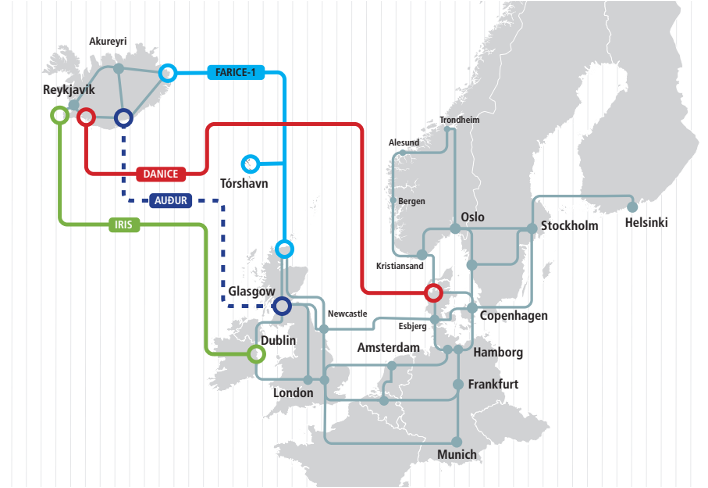
Graphic courtesy of Farice
Scotland as a Digital Crossroads
The choice of Scotland as the landing point is no accident. The country’s geographic position makes it a natural bridgehead for transatlantic data traffic, and Farice’s decision to route through Glasgow or Edinburgh signals confidence in Scotland’s telecoms ecosystem and its connections southward into the rest of the UK and Europe.
For Scottish businesses, technology firms, and data centre operators, the AUÐUR cable offers tangible benefits. Reduced latency between Iceland and key European network hubs means faster, more reliable connectivity for cloud services, financial data, and digital platforms. As hyperscale data centre investment continues to surge across the British Isles, having diverse, resilient cable routes landing in Scotland strengthens the country’s pitch as a location for high-value digital infrastructure.
Riding the Data Centre Wave
Farice CEO Thorvardur Sveinsson is explicit about what’s driving demand. “Icelandic data centres can be seamlessly integrated into network topologies, bridging the US and Nordic markets,” he said. “The Nordic region is rapidly emerging as a major data centre hub, making interconnectivity with the Nordics ever more important.”
Iceland has become an increasingly attractive data centre destination thanks to its renewable geothermal energy, cool climate, and political stability. The AUÐUR cable will make it easier for operators there to plug into European and transatlantic networks — and Scotland sits directly in the middle of that corridor.
The cable is projected to include 16 to 24 fibre pairs, giving it substantial capacity to handle the rapidly growing volumes of data traffic expected over the coming decade. Farice already operates three submarine cables — FARICE-1, DANICE, and ÍRIS — and AUÐUR will significantly extend the company’s network reach and resilience.
A High-Growth Infrastructure Moment
Scotland has been quietly building credibility as a destination for digital and tech infrastructure investment, from space launch facilities to data centres and subsea cable landings. The AUÐUR project adds another layer to that story, connecting Scottish shores to a fast-growing Nordic digital economy and reinforcing the country’s role in global connectivity.
With formal preparations now underway, all eyes will be on which Scottish city — Glasgow or Edinburgh — secures the landing station, and what downstream economic and connectivity benefits follow.